How Much Does a Functional Prototype Cost? Budgeting the Whole Program
What a functional prototype program costs: parts, sets, iterations, production-like materials, finishing, hardware, CAD work and testing, with a worksheet.
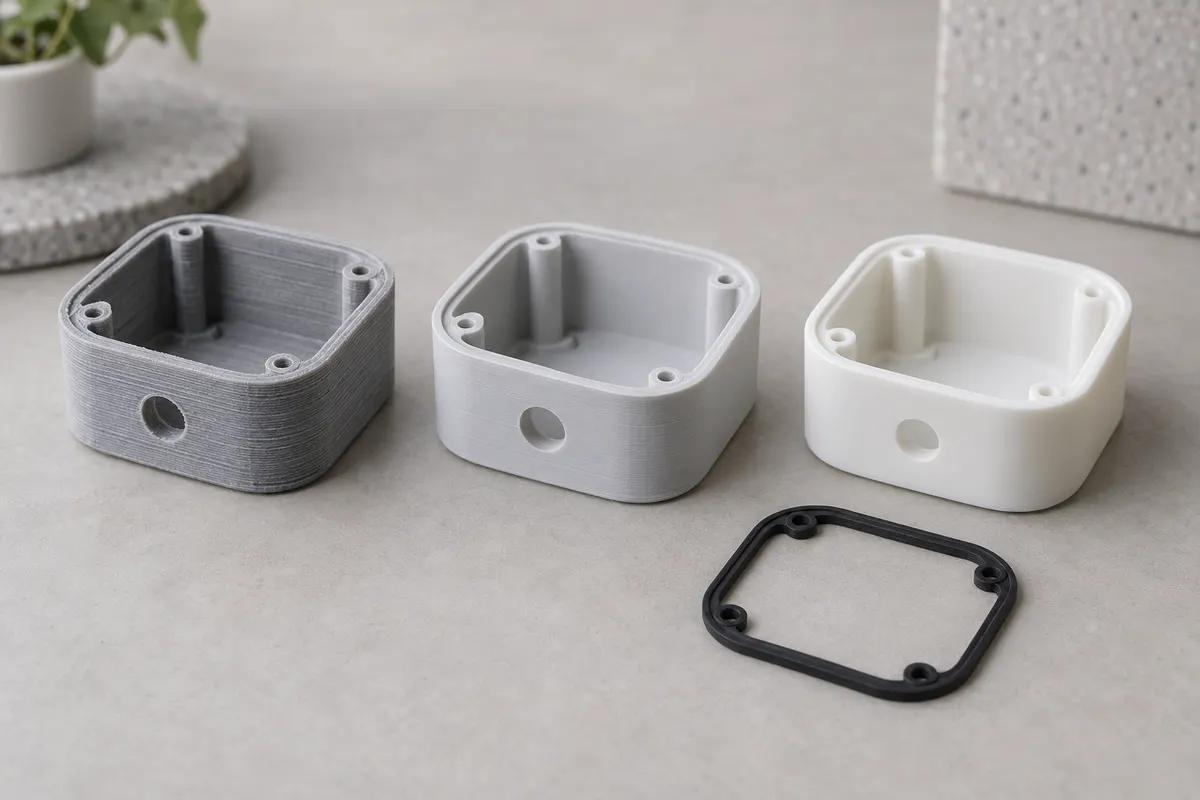
The Short Answer
A functional prototype costs the sum of every part you print across every set and iteration, plus finishing, hardware and assembly, any design work, and the testing your own team does. The per-part price comes from a quote on your actual files, but the program total depends mostly on how many parts, sets and rounds you plan. Count those first, then price them: the worksheet below does that without guessing. For typical per-part price ranges, see how much 3D printing costs.
What Goes Into the Total
A prototype budget built from one part's price is almost always short, because most of the lines multiply. Here is what to count.
| Cost line | What drives it | Where the number comes from |
|---|---|---|
| Printed parts | Parts per set × sets × rounds | A quote on your files |
| Material | Production-like grades cost more | The quote, material by material |
| Finishing | Surfaces that must look or seal like production | Quoted by the team on request |
| Inserts and assembly | Threaded joints, assembled sets | Quoted by the team on request |
| Purchased hardware | Bearings, springs, magnets, fasteners | Your suppliers |
| Design and CAD work | Changes between rounds, new parts | Your hours, or a per-project quote |
| Testing | Fixtures, instruments, staff time, parts consumed | Your team's estimate |
| Shipping | One shipment per print round | Each order |
Each Stage Changes What You Print
Prototypes cost least when each one answers a specific question. A product design lecture in MIT's Engineering for Impact course states the strategy plainly: identify the risks and uncertainties, formulate the questions that will reduce them, and get the answers the fastest, cheapest way possible. The same lecture separates works-like from looks-like prototypes, and low-fidelity models (quick, cheap, many iterations) from high-fidelity ones (refinement and detail). Printing suits that rhythm: NIST's review of additive manufacturing costs notes that, with the exception of design cost, each product can be customized at little or no expense, so a change between rounds costs a new print of the changed part rather than a change to a tool.
| Stage | Question | What to print | Budget note |
|---|---|---|---|
| Looks-like | Does it look and feel right? | SLA or PLA, finished where seen | Few sets; finish is the cost |
| Works-like | Does it fit, move and hold? | Production-like materials, real hardware | Several rounds; reprint only changes |
| Pre-production | Does the final design pass tests? | Production-intent grade, frozen revision | More sets, few changes |
Stage by Stage in Practice
- Looks-like: appearance drives the cost, so finish only the faces people judge. SLA gives small appearance parts smooth surfaces and fine detail; FDM vs SLA compares the two. Count how many reviewers need their own set.
- Works-like: material and hardware drive the cost. Print in a material that behaves like production where the test depends on it, install real inserts where screws come and go, and plan the assembly as components; working prototype assemblies covers hardware and assembly. Reprint only the parts that change.
- Pre-production: quantity and documentation drive the cost. These parts go to tests your team runs, so put the grade, orientation and critical dimensions on the drawing (specifying parts for validation tests) and freeze the revision before ordering the sets.
- Across all three: the rapid prototyping guide maps materials and processes to each stage.
Material That Behaves Like Production
A works-like prototype is only as useful as its material is honest. A part that passes in a stiffer or tougher material than production proves little, and a part that fails in a weaker one sends you back for a reprint. Nylon shows how a hidden variable creeps in: Polymaker's sheet for its PolyMide PA6-CF describes nylon as hygroscopic, notes that most nylon parts in real use become moisture conditioned, and explains that conditioning improves toughness and flexibility while reducing tensile strength and stiffness. If your test depends on that, budget for conditioning parts before testing (nylon dimensions and moisture conditioning). Start from the materials page and match the production material's job, not its name. And a printed part is not a molded part, so a printed prototype that passes does not prove the molded part will.
Finishing, Inserts and Assembly
These lines are handwork on every part, so they scale with sets and rounds. On FDM parts we offer sanding, vapor smoothing (ABS and ASA), painting, threaded insert installation, dyeing and assembly. Standard parts ship as printed with support material removed; SLA support marks on the bottom face are sanded by default, and polish, paint and dye are add-ons. Post-processing is quoted on request. In works-like rounds, consider leaving cosmetic finish off parts that will change again and adding it in the final round. Where a screw is removed and refitted during testing, budget for threaded inserts (heat-set inserts and threads). Hardware you buy for the prototype, such as bearings, springs and magnets, belongs on the worksheet as its own line.
Design Work and Testing
Two lines are easy to forget because they are not printing. Design work covers the changes between rounds, new parts and any reverse engineering. If your team does the CAD, budget its hours; if you need help, 3D modeling services quotes each project with a fixed price and schedule before work starts, with no obligation to proceed. The free printability review is separate: an engineer checks walls, tolerances, orientation and material choice at no cost and with no obligation to order, and it is a printability review, not engineering validation. Testing is your team's line: fixtures, instruments, staff time and the parts each test consumes. A test to failure consumes a set, so count destructive tests as sets.
Budgeting Worksheet
Fill in one copy per stage. Take per-part prices from a quote on your files, multiply across, then add the lines that are not printing. Leave a line blank rather than guess, and come back to it.
| Line | How to fill it in | Your figure |
|---|---|---|
| A. Printed parts per set | Count from the assembly's parts list | ____ |
| B. Sets per round | Units to test, review, break and keep | ____ |
| C. Rounds in this stage | Planned iterations for this stage | ____ |
| D. Parts reprinted per later round | Only the parts expected to change | ____ |
| E. Parts printed this stage | A × B, plus D × B for each later round | ____ |
| F. Printed parts cost | Each part's quoted price × its count, summed | ____ |
| G. Finishing, inserts, assembly | The quote's post-processing lines | ____ |
| H. Purchased hardware | Bearings, springs, magnets, fasteners | ____ |
| I. Design and CAD work | Your hours, or a per-project quote | ____ |
| J. Testing | Fixtures, instruments, staff time | ____ |
| K. Shipping | One shipment per round | ____ |
| Stage total | F + G + H + I + J + K | ____ |
Hypothetical Example: Counting Parts and Rounds
Hypothetical example: a handheld device with six printed parts (top and bottom housings, a battery door, a button cap, a flexible gasket and an internal bracket). The plan below counts parts and rounds only; multiply each count by the per-part prices on your own quote to turn it into a budget.
| Stage and round | Sets × parts | Parts printed |
|---|---|---|
| Looks-like, round 1 | 2 sets × 6 parts | 12 |
| Works-like, round 1 | 2 sets × 6 parts | 12 |
| Works-like, round 2 (3 parts change) | 2 sets × 3 parts | 6 |
| Works-like, round 3 (1 part changes) | 2 sets × 1 part | 2 |
| Pre-production, frozen revision | 5 sets × 6 parts | 30 |
| Total | 5 print rounds | 62 |
What the Example Shows
- The pre-production sets are 30 of the 62 parts, almost half the printing in this plan. Settling the design before that round protects the largest line.
- Reprinting only the changed parts kept works-like rounds 2 and 3 to 8 parts. Reprinting full sets would have been 2 × 6 + 2 × 6 = 24.
- Hardware scales the same way: four inserts per set across the seven complete works-like and pre-production sets is 28 installations.
- The gasket is a different material from the housings, so it is priced in its own group. Quantity tiers are applied automatically and count parts within the same process and material, so price the whole stage's quantity, not one set.
Keeping the Program Total Down
Part-level tactics (material, volume, orientation, splitting, finish and quantities) are in how to reduce 3D printing costs. At program level, a few habits do most of the work.
- Reprint only what changed, and change one thing at a time when tuning a fit.
- Order the sets a stage needs together, including the spares destructive tests will consume.
- Freeze the revision before pre-production sets; a change after that repeats the largest round.
- Quote the whole set early, even before the design is final, so the budget starts from real per-part prices.
- With an account, "Order this again" on a past order starts a fresh quote from the same files and configuration, priced at current rates, which makes repeat sets of a frozen revision simple.
Getting Prices for the Worksheet
Upload every part to the quote page, set the process, material, color and quantity for each, and download the quote as a PDF for the budget request. One order can mix FDM and SLA parts, each priced by its own process and material. When you give your contact details, tick Engineering / DFM review for the free printability review, and invoice / PO if you need one. We accept purchase orders and issue invoices, with net terms available on approval; purchase orders go through the PO page. For an overview of prototype work, see 3D prototype services.
Frequently asked questions
How much does a functional prototype cost?
How many iterations should we budget for?
Do functional prototypes need production materials?
Is CAD or design work included in the print price?
Can we get a written quote for budget approval?
Sources
Price a full prototype set
Upload every part of the assembly to get per-part prices for your worksheet, then download the quote as a PDF for your budget request.
Upload your parts