Threaded Inserts in 3D Printed Parts: FDM vs SLA, Hole Sizes, and Installation Options
Heat-set inserts for FDM, press-in or bonded inserts for cured SLA resin, hole sizes from the insert's datasheet, and when tapping or printed threads will do.
The Short Answer
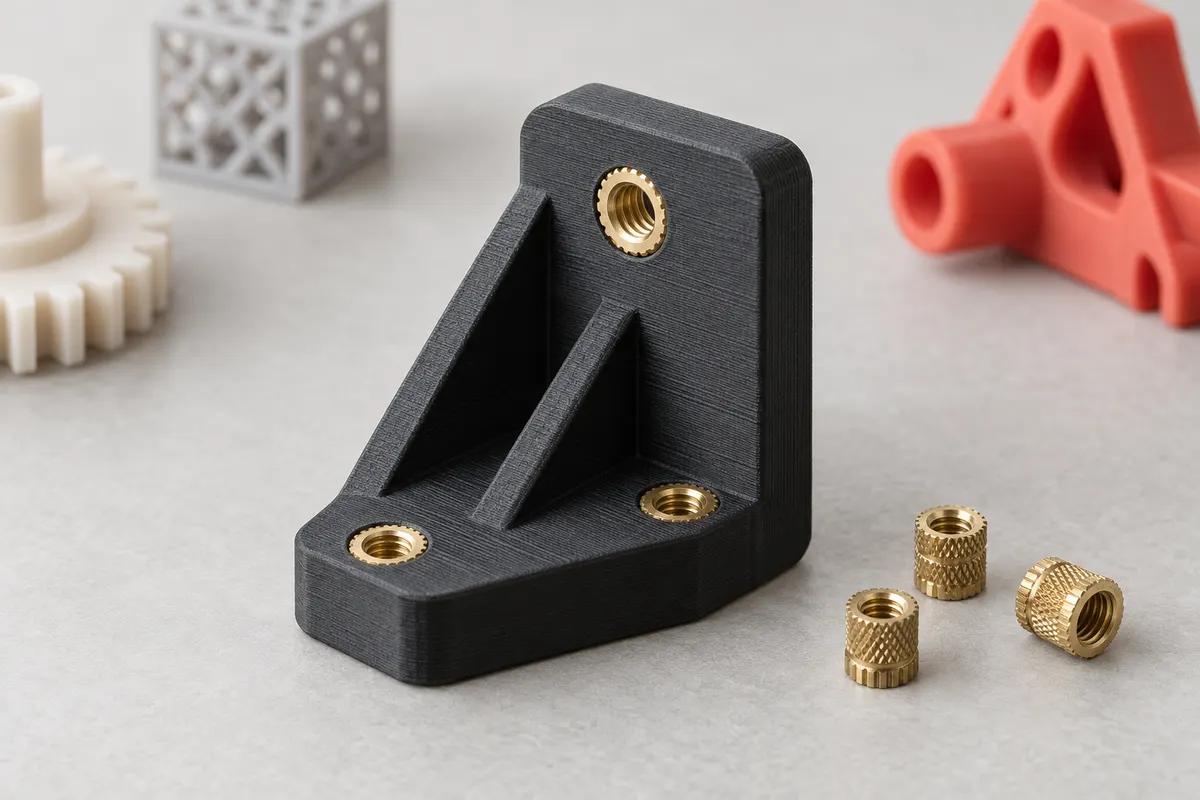
In FDM parts, use heat-set inserts in a thermoplastic, with each hole sized to what the insert maker specifies for that exact insert, not to the screw size. Cured SLA resin is a thermoset that does not soften again, so conventional heat-setting does not apply; press-in, self-tapping or adhesive-bonded inserts are the sound options there, and we review them part by part. Printed threads and tapped holes need no hardware and suit coarse, low-torque joints that are rarely taken apart. We install threaded inserts in FDM parts as a post-processing option quoted on request.
Choose the Method by Host Material
The plastic around the insert decides most of this. Heat and ultrasonic inserts are designed for thermoplastics, which soften under heat and re-solidify around the insert's knurls. SPIROL's design guide states plainly that they are not suitable for thermosets, which cannot be re-formed with heat and pressure, and that thermosets call for molded-in, press-in or self-tapping inserts. E-Z LOK gives the same rule: for a thermoset, use a method that does not rely on melting, such as press-in.
| Method | Host material | Thread | Best fit |
|---|---|---|---|
| Heat-set insert | FDM thermoplastics | Metal | Serviced or torqued joints |
| Press-in insert | Thermoplastic or cured resin | Metal | Moderate loads, simple install |
| Self-tapping insert | Thermoplastic or cured resin | Metal | Where pressing is impractical |
| Bonded insert | Cured resin | Metal | When heat or press-fit will not work |
| Tapped hole | Solid plastic walls | Plastic | Few assemblies, low torque |
| Printed thread | Coarse threads | Plastic | Plastic-to-plastic, low torque |
Heat-Set Inserts in FDM Parts
A heat-set insert is heated and pressed into an undersized hole. The plastic around it softens, flows into the knurls and grooves, and locks the insert when it cools. SPIROL notes the heated insert should soften the plastic, not melt it, and that a piloted tip should guide the insert. Its 3D printing white paper puts installation quality at as much as 70% of an insert's performance, with alignment, temperature and pressure all mattering. What that means for the part:
- The rigid FDM thermoplastics we print, such as PETG, ABS, ASA, PC and the nylons, are candidates. Flexible TPU is an elastomer, and SPIROL says elastomers have limited suitability for inserts and need an application analysis.
- Filled grades such as PA6-CF or PETG-CF behave differently. SPIROL enlarges the recommended hole for glass- or mineral-filled plastics and recommends consulting its engineers, so treat a filled filament as a case to test.
- The boss needs solid plastic. In SPIROL's tests of an M6 insert in printed PLA, performance rose with infill and with the number of perimeter walls. It recommends a solid boss at least 1.5 times the insert's knurl diameter (2 times for maximum performance) and infill above 50%. Our infill guide explains why walls carry so much of the load.
- SPIROL's white paper also notes that thicker layers generally give weaker inter-layer bonding, which is one more reason to keep insert bosses out of the weak direction described in our orientation guide.
Size the Hole From the Insert's Datasheet
There is no universal hole size for an M3 or 1/4-20 insert. The insert's outside diameter is larger than the screw it accepts, and the hole is sized to the insert body, which differs between series, lengths and makers. SPIROL publishes one hole diameter per thread size within a given straight-hole series. PEM's MSIB bulletin lists the mounting-hole diameter and minimum depth by thread size and length code. E-Z LOK calls its published sizes a general guideline and recommends testing to find the exact size before production. So name the insert by manufacturer and part number, and model the hole that datasheet gives. Hole size is also where printing tolerance meets insert tolerance. SPIROL warns that larger holes decrease performance, while smaller holes induce stress, can crack the plastic and leave flash. Its white paper notes that printing tolerances often exceed the hole tolerance its catalog recommends. It offers two remedies: drill the hole after printing, which reduces variation but can cut through the perimeter walls that reinforce an FDM hole, or iterate the printed size until it works. For a production run, a test part in the same material and orientation settles the size before the full quantity is built. Our tolerances guide covers what typical FDM and SLA accuracy means for a fit like this.
Straight or Tapered Holes, and How Deep
- Match the hole to the insert. SPIROL specifies straight holes with no more than a 1° included taper for straight inserts and an 8° included taper for tapered inserts, and says not to mix them. Some symmetrical designs, such as PEM's MSIB, are made for either kind of hole.
- Tapered holes help seat and align the insert before heat is applied. SPIROL warns against tapered inserts in pull-through joints or thin-walled bosses, where they can crack the plastic.
- Make the hole deeper than the insert. SPIROL's minimum is the insert length plus two thread pitches (1.2 times the length for self-tapping inserts), and the screw must never bottom out in the hole, or it jacks the insert out.
- Plan for flush. SPIROL installs the top of the insert flush with the surface, protruding no more than 0.13 mm.
- Size the hole in the mating part too. It must clear the screw but stay smaller than the insert's pilot or face diameter, so the insert carries the load rather than pulling through. If alignment needs a bigger hole, SPIROL suggests a headed insert.
Leave Room for the Tool and Keep It Square
SPIROL calls proper alignment between insert and hole essential, helped by a tapered insert or a pilot, and says a fixture should give straight axial insertion. Design for that:
- Give each hole a straight, unobstructed line of approach for the installation tip. Overhangs, ribs and nearby walls block it. SPIROL uses extended tips for recessed holes, but a hole the tool cannot reach square cannot be installed well.
- Put the hole axis perpendicular to a face the part can rest on while the insert is pressed in.
- In FDM, a hole whose axis runs vertically in the build is traced as a circle in every layer, while a horizontal hole is built up from stacked layers. Where several holes point different ways, orientation is one of the things our free printability review checks.
- Keep bosses away from thin edges, so the wall around the insert does not bulge during installation.
Inserts in SLA Resin Parts
SLA cures liquid resin into a cross-linked thermoset. OpenStax's additive manufacturing text notes that once hardened, thermosets cannot be reprocessed, and SPIROL's 3D printing white paper says cured SLA resin decomposes rather than melts at high temperature. A heat-set insert relies on the plastic softening around it, so it is the wrong tool for an SLA part. The options insert and adhesive makers describe for cured resin are cold ones:
- Press-in inserts. SPIROL rates them the most effective choice for thermosets. Pressing in cold puts more stress on the boss, and SPIROL says cold-pressed inserts need larger bosses or thicker walls than heat-installed ones. An undersized hole in a stiff, brittle resin is where cracks start, which is one reason resin choice matters; our engineering SLA resins guide compares Tough Resin, Durable Resin and others.
- Self-tapping inserts. SPIROL calls them viable, needing less installation force but giving lower back-out torque, and notes they can thread out of an assembly that is taken apart.
- Adhesive-bonded inserts. Henkel's Loctite 3D printing bonding guide rates several adhesive types on SLA and DLP parts, says the surfaces must be free of contamination such as grease and dust, and explains that the bond gap decides whether the joint is rigid or flexible. The adhesive has to be chosen for the specific resin and load, and the joint tested.
- Expansion-style inserts are the simplest to install, but SPIROL ranks their performance lowest of all styles.
How We Handle SLA Inserts
We review inserts in resin parts one part at a time rather than promising a method. Send the insert part number, the load and how often the joint will be taken apart through the contact page, and the team confirms what it can do for that part before you order.
Printed Threads, Tapping and Other Alternatives
Inserts are not always worth the cost. These alternatives hold up when the joint is lightly loaded or rarely opened:
- Printed threads. Model the thread into the part and design the clearance in, then confirm the fit with a test print. They suit coarse threads in plastic-to-plastic joints such as caps and adjustment collars. SLA reproduces finer detail than FDM, and in FDM a thread whose axis runs vertically comes out rounder than one lying on its side.
- Tapped holes. Print or drill the hole at the drill size the tap maker gives for that tap, because cutting taps and thread-forming taps need different holes. Cut the thread into solid walls, not infill. A tapped thread is plastic, so it wears in a way an insert's metal thread does not; SPIROL lists reusable threads as the first reason to use an insert.
- Thread-forming screws for plastics. TR Fastenings publishes guideline pilot holes by screw size and plastic, recommends bosses 2.5 to 3 times the pilot diameter, and says the final pilot hole should be set by application testing.
- Captured nuts. E-Z LOK describes a cavity sized to the nut. A hex pocket the nut slides into after printing does the same job as embedding a nut mid-print, without stopping the build.
How to Specify Inserts on Your Quote
Parts ship as printed unless finishing is specified, so inserts are installed only when you ask for them. Threaded insert installation is one of our FDM post-processing options, quoted on request. When you request a quote, send the team these details through the contact page:
- The insert's manufacturer and part number for each size. If you have not chosen one, give the thread size, length and type you need so the choice can be settled with you at quote time.
- A hole modeled to that insert's datasheet: diameter, straight or tapered, and depth.
- Each location, on a marked-up drawing or screenshot.
- The load on the joint and how often it will be assembled.
- The process and material for each part. One order can mix FDM and SLA parts.
What the Review Covers
Our free printability review checks walls, tolerances, orientation and material choice before you order. It is not a pull-out or torque test. If a joint has a specified load, test the first parts; PEM recommends testing its inserts in the actual application. If the model needs bosses or holes redrawn to suit an insert, our 3D modeling service quotes that work at a fixed price before it starts.
Frequently asked questions
What hole size should I use for an M3 heat-set insert?
Can you heat-set inserts into SLA resin parts?
How deep should the hole for an insert be?
Are printed threads strong enough instead of inserts?
Is insert installation included in the instant price?
Sources
- SPIROL: How to Select a Threaded Insert for Your 3D Printed Assembly (white paper)
- SPIROL: Inserts for Plastics (design guide)
- SPIROL: How to Design the Proper Hole for Heat / Ultrasonic Inserts
- PennEngineering (PEM): microPEM Type MSIB Inserts for Plastics bulletin
- E-Z LOK: How to Install Threaded Inserts in Plastic
- E-Z LOK: Why You Should Use Threaded Inserts for 3D Printing
- Henkel: Loctite 3D Printing Bonding Guide
- TR Fastenings: Plas-Fix 45 screws installation guide
- FM Carbide: Tapping formulas
- OpenStax (Workforce LibreTexts): Additive Manufacturing Essentials, 3.1 Polymer Materials
Get your inserts priced with the part
Upload the part for an instant price, then send each insert's manufacturer part number and location through the contact page. FDM insert installation is quoted on request, and inserts in SLA parts are reviewed per part.
Upload your part