Can You 3D Print a Fully Assembled, Working Prototype?
Yes, part by part. How a printed prototype assembly comes together: components, purchased hardware, fit checks, assembly, and what to send for a quote.
The Short Answer
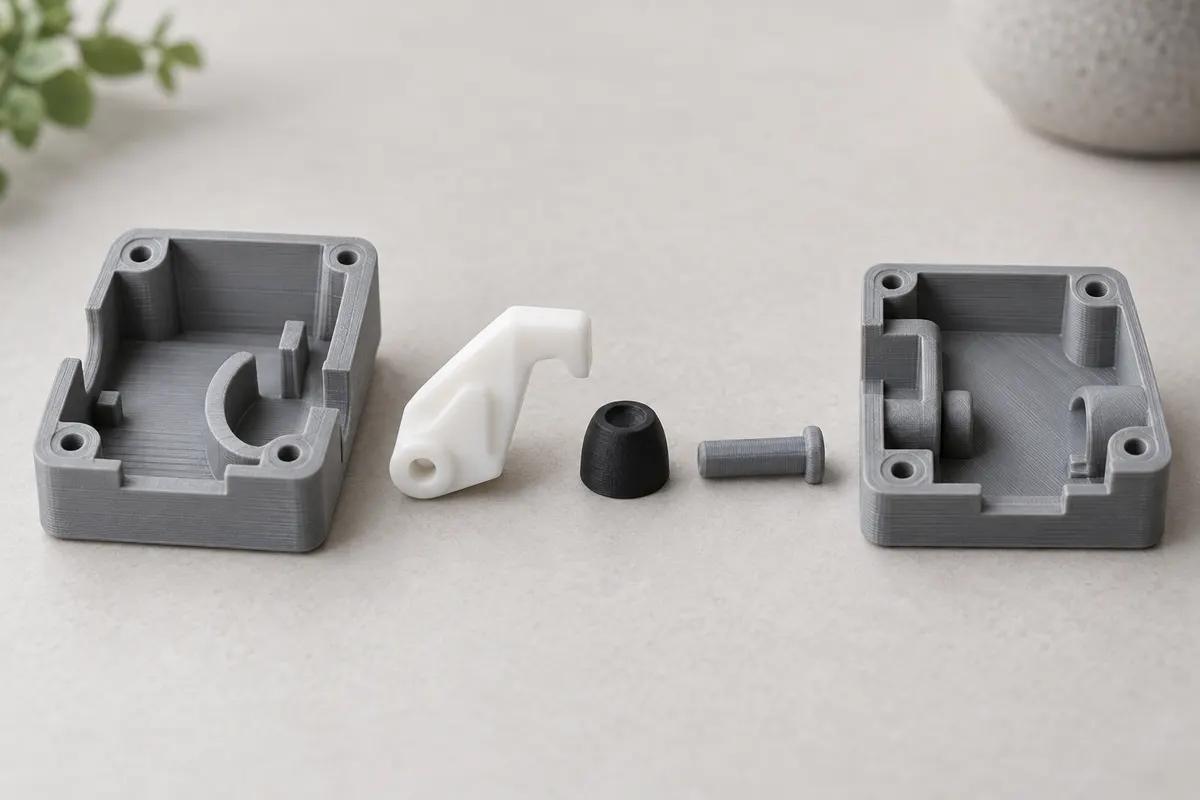
Yes. Each component is printed in the process and material it needs, FDM, SLA or a mix of both on one order, and the set can be assembled with threaded inserts, screws, bearings, springs or magnets to your files and instructions. What printing and assembly cannot tell you in advance is whether the mechanism works: that depends on the design, and testing the prototype is how you find out. Start with one complete set, test it, and order more once it behaves.
Visual or Functional: Decide First
The two kinds of prototype answer different questions. Deciding which one you need settles the process, the materials and how much hardware is worth installing. Many programs need both, and they can be separate parts on the same quote.
| Aspect | Visual prototype | Functional prototype |
|---|---|---|
| Answers | How does it look and feel? | Do the parts fit, move and hold? |
| Usual process | SLA for smooth, detailed surfaces | FDM or SLA, chosen part by part |
| Usual materials | Standard Resin, PLA | ABS, PC-ABS, nylon, TPU, Tough Resin |
| Hardware | Often none | Real inserts, screws, bearings, springs |
| Does not prove | Strength, fit or durability | That a molded part will behave the same |
Plan the Assembly as Components
A working prototype is a set of parts, and each part gets its own process, material, color and quantity on a single quote. A housing that needs toughness can print in FDM in PC-ABS, a small detailed latch in SLA Tough Resin, and a seal in TPU 85A. Mixing FDM and SLA in one order explains how such an order is priced and sized. The table below gives starting points by the job each part does.
| Component role | FDM starting point | SLA starting point |
|---|---|---|
| Housings and covers | ABS, ASA outdoors, PC-ABS | Tough Resin |
| Clips and snap arms | PC-ABS, PA12, TPU 64D | Tough or Durable Resin |
| Seals, bumpers, grips | TPU 85A | Flexible or Rubber-Like Resin |
| Stiff brackets, fixtures | PA6-CF, PA12-CF, PETG-CF | Glass-Filled Rigid Resin |
| Small, detailed parts | Usually SLA instead | Standard or Tough Resin |
| Parts near heat | PC, PA-CF | High-Temperature Resin |
Size Limits and Material Advice
Each part has to fit its process in one piece, in any orientation: FDM 350 × 320 × 325 mm, SLA 353.2 × 198.7 × 400 mm. A part that does not fit gets no instant price and goes to large-format review, where it can be split into sections and assembled (large-format printing). If you are unsure about a material, our free printability review has an engineer check each part's walls, tolerances, orientation and material choice at no cost and with no obligation to order. It is a printability review, not an engineering sign-off on the design.
Purchased Hardware: Supplied or Specified
Hardware reaches the assembly one of two ways. You send it, or you specify each item exactly (manufacturer, part number, quantity) and the team confirms whether it can supply it for that project. Either way, model the printed geometry from the supplier's drawing of the real part, not from a nominal size.
| Hardware | Tell us | Design around |
|---|---|---|
| Threaded inserts, screws | Part number and locations | Hole size and boss wall |
| Bearings, bushings | Part number and which bore | How the bearing is retained |
| Springs | Part number or full spec | Pocket and guide clearance |
| Magnets | Size, grade, which pole faces out | Pocket, retention, heat |
| Pins, shafts, dowels | Diameter and tolerance | Press fit or clearance |
Hardware Design Notes
- Threaded inserts: SPIROL's study of inserts in printed parts found hole size critical to insert performance, recommends refining it over several prints, and suggests a boss at least 1.5 times the insert's knurl diameter (2 times for maximum performance). Heat-installed inserts outperformed press-in inserts in the FDM materials it tested. We install heat-set inserts in FDM parts as a post-processing option; see heat-set inserts and threads.
- Inserts in resin: SPIROL notes that SLA materials are primarily thermosetting plastics, so heat-set inserts do not apply; press-in inserts are the effective choice there, and self-tapping inserts are a viable alternative. Cured resin cannot be turned back into liquid, which is why it does not re-melt around a hot insert. Mention resin inserts in your request so the team can confirm the approach.
- Bearings and pressed pins: DuPont's design guide notes that plastic creeps and relaxes under a press fit, so some loosening should be expected, and recommends testing under the temperature cycles the part will see. Knurls or grooves help the plastic keep its grip, and a shoulder with a retaining cap holds a bearing without relying on interference alone.
- Springs: Lee Spring defines a compression spring by its outside diameter, wire diameter, free length, solid height and rate. The pocket must be larger than the outside diameter, with allowance for tolerance and for the spring's expansion under load, and a guide rod smaller than the inside diameter reduces buckling.
- Magnets: Eclipse Magnetics rates standard neodymium grades (no letter after the number) to 80 °C; above a magnet's maximum operating temperature, the strength it loses does not return on cooling. Mark which pole faces out on every magnet, because one installed backwards repels its partner.
Fit Checks Before Function
Most first-assembly problems are fit problems. As general guidance FDM parts hold ±0.2 mm and SLA parts ±0.1 mm, and those variations add up through every part in a chain. Daniel Whitney's MIT assembly course notes describe worst-case tolerancing as assuming every error sits at its limit at once, so error grows in step with the number of parts; statistical (root-sum-square) tolerancing grows only with its square root, and only when parts are centered on nominal. Hypothetical example: a lid that locates through three stacked FDM parts, each ±0.2 mm, can be off by up to ±0.6 mm in the worst case. Keep critical interfaces between as few parts as possible, mark the dimensions that matter, and see snap fits, press fits and clearances for starting clearances.
Orientation Changes Strength
Printed parts are not equally strong in every direction. A 2021 review of anisotropy in printed polymers reports that FDM's direction dependence can reach almost 50%, while SLA's is around 1%. A snap arm, hinge or boss that carries load across FDM layers is the first thing to fail on the bench, which is why orientation is part of the printability review. Print orientation and strength covers it in detail.
What Assembly Covers, and What It Does Not
Assembly is one of our post-processing options, quoted on request. Every part is printed to the file you send, and the uploaded file is never altered. If the design needs to change, our 3D modeling service quotes CAD work separately, with a fixed price and schedule before any work starts and no obligation to proceed.
| We do | You own |
|---|---|
| Print each part to your files | The design, fits and hardware choice |
| Install threaded inserts in FDM parts | Whether the mechanism works as intended |
| Assemble to your drawing and instructions | Testing against your requirements |
| Check printability in the free review | Engineering validation, any certification |
Why One Prototype Comes First
The first complete set is where the design meets the real parts. A stack that closed on screen binds, a snap arm is too stiff, a spring pocket is short. Each of those is a design change, and it costs less to find on one set than on twenty. Order one prototype, test it, revise the parts that need it, and reprint only the changed parts in the next round. When the design is settled, order the quantity you need; quantity pricing tiers are applied on the quote automatically. The rapid prototyping guide and small-batch production cover the steps after that.
What to Send for a Quote
Upload every printed part at the quote page for per-part pricing, and send the drawing, hardware list and instructions through contact. A real person answers email within one business day. Our prototype services page describes the service as a whole.
- CAD for every printed part. STEP, 3MF and IGES carry their units; STL and OBJ are read as millimeters. See CAD file formats.
- An assembly drawing, exploded view or assembly file showing how the parts go together.
- Process, material and color for each part, or the job each part does if you want a recommendation.
- Quantity: one complete set to start.
- A hardware list: item, manufacturer, part number, quantity, and whether you will supply it.
- Threaded insert sizes and locations.
- Critical dimensions and fits, marked on a drawing or screenshot.
- The assembly sequence, if the order of assembly matters.
- How you plan to test the prototype, so the printability review looks at the right features.
Frequently asked questions
Can you assemble parts printed in different processes?
Do you supply the screws, bearings and other hardware?
Will the assembled prototype work?
Should I order several sets at once?
Can heat-set inserts go into SLA resin parts?
Sources
- SPIROL: How to Select a Threaded Insert for Your 3D Printed Assembly
- DuPont: General Design Principles for DuPont Engineering Polymers (Design Guide Module I)
- Lee Spring: Learn About Compression Springs
- Eclipse Magnetics: Neodymium Magnets (NdFeB) grades data
- MIT OpenCourseWare, Daniel E. Whitney: Variation Buildup in Assemblies-2 (2.875)
- Zohdi and Yang, Polymers (2021): Material Anisotropy in Additively Manufactured Polymers and Polymer Composites: A Review
- Pagac et al., Polymers (2021): A Review of Vat Photopolymerization Technology
Upload your assembly for review
Upload every part of the assembly for per-part pricing, then send the drawing and hardware list so an engineer can check printability before anything prints.
Upload your assembly