ASA vs ASA-CF for Custom Enclosures, Bezels, and Mounting Parts
When to pick ASA or carbon-fiber ASA for enclosures, bezels and brackets: stiffness, toughness, finish, orientation, UV and warp, from datasheet values.
The Short Answer
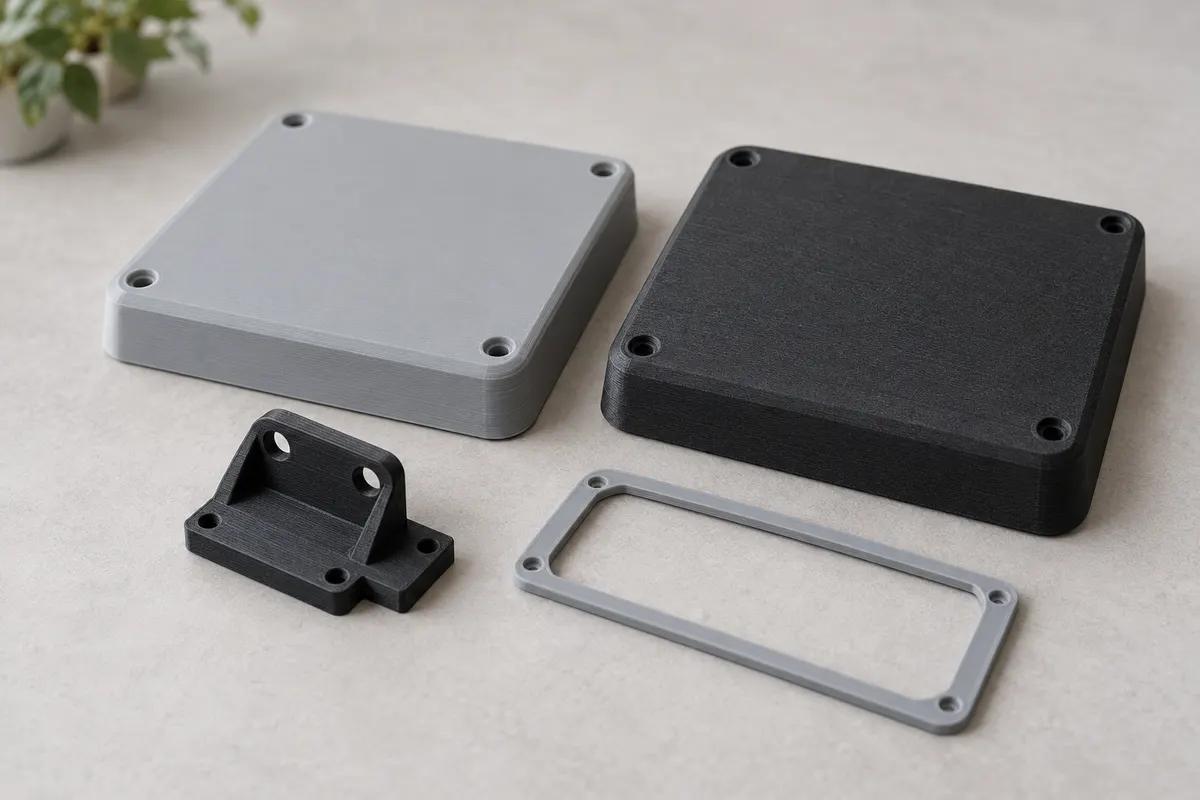
Choose ASA for enclosure bodies, lids, snap-fit covers and anything that may be dropped or flexed during assembly. Choose ASA-CF for flat panels, rails and mounts where low warp, in-plane stiffness and a matte surface that hides layer lines matter more than impact toughness. Carbon fiber is not a general strength upgrade: in one maker's datasheets it raised in-plane tensile stiffness by about half, left tensile strength unchanged, and cut elongation and notched impact strength sharply. Both are ASA underneath, so the choice is stiffness and finish against toughness, not outdoor durability.
What the Fiber Changes: One Maker's Data
The fairest comparison is two datasheets from the same maker, tested the same way on printed specimens. Polymaker publishes both: Polymaker ASA, and Fiberon ASA-CF08, which contains 8% carbon fiber by weight. The values below are that manufacturer's typical datasheet values for those two grades, printed at 100% infill and tested to ISO 527, ISO 178 and ISO 179. X-Y is the direction within a layer; Z is across layers. They are not values for parts we print, other ASA-CF grades will differ, and the two sets of specimens were printed with similar but not identical settings, so read the comparison for direction rather than decimals.
| Datasheet value | Polymaker ASA | Fiberon ASA-CF08 | Change |
|---|---|---|---|
| Tensile modulus, X-Y | 2,379 MPa | 3,612 MPa | About 50% stiffer |
| Tensile modulus, Z | 1,965 MPa | 1,904 MPa | No gain |
| Flexural modulus, X-Y | 3,206 MPa | 3,265 MPa | About the same |
| Tensile strength, X-Y | 43.8 MPa | 43.5 MPa | About the same |
| Tensile strength, Z | 32 MPa | 25.0 MPa | Lower |
| Elongation at break, X-Y | 6.7% | 1.8% | Much lower |
| Notched Charpy, X-Y | 10.3 kJ/m² | 5.5 kJ/m² | About half |
| HDT at 1.8 MPa | 100 °C | 97.3 °C | About the same |
Stiffness and Toughness Are a Trade
In that pair, the carbon grade stretched about 1.8% before breaking in the layer plane, against 6.7% for unfilled ASA, and absorbed about half the notched impact energy. Its stiffness gain showed in tension; its flexural modulus barely moved. So if bracket deflection is the reason you are considering carbon fiber, compare the flexural modulus of the specific grade, and remember that rib depth and wall thickness usually change bending stiffness more than a change of material does. The broader picture for fiber-filled filaments is in our carbon fiber 3D printing guide. For enclosure features, the trade looks like this:
- Snap-fit hooks and latches: a hook that deflects comfortably in ASA has much less margin in ASA-CF. Keep snaps in ASA, or design them for far lower strain. See snap fits and press fits.
- Press-fit bosses and thin lid lips: low elongation leaves little room for interference. Heat-set threaded inserts are a common alternative in either material (inserts and threads).
- Drops and knocks: handheld housings, corners and covers that get bumped favor ASA.
- Steady loads in the layer plane: mounts and stand-offs loaded along the layers can use ASA-CF's higher tensile stiffness.
Orientation Matters More With Fiber
Short fibers line up with the extruded bead. In an Oak Ridge National Laboratory study of carbon-fiber ABS, a close relative of ASA, printed samples reached up to 91.5% fiber orientation in the printing direction, and higher fiber content brought more small voids inside each bead. The fiber helps along the bead, within a layer, and does little across layers. The Polymaker data shows the same pattern: the carbon grade gained stiffness in X-Y but not in Z, and its across-layer tensile strength was about 57% of its in-plane value, against about 73% for unfilled ASA.
- Orient brackets so the main bending load runs within the layer plane, not across layer lines. Our guide to print orientation and strength shows how.
- Avoid features whose only load path crosses layers, such as a tall post loaded sideways or a screw boss pulled along its axis on a part printed upright.
- When you quote, send the faces and loads that matter through the contact page. Orientation is part of the free printability review.
Surface Finish for Bezels and Visible Faces
Polymaker describes ASA-CF08 as having a matte finish that hides layer lines, which is why carbon grades suit bezels, faceplates and trim that sit in plain view. Unfilled ASA shows layer lines more as printed, but it can be sanded, painted or vapor smoothed (we offer vapor smoothing for ABS and ASA). Post-processing is quoted on request. If a bezel carries a display window or light pipe, remember that ASA-CF's low elongation leaves little room for a tight press fit around it. Check the colors offered for each material on the quote page before you decide on looks.
Outdoors: UV, Weather and Heat
INEOS Styrolution, which makes the Luran S ASA resin, says ASA keeps its strength, gloss and color under prolonged sun, heat and moisture, credits its acrylate rubber content for resistance to stress cracking, and lists outdoor uses such as mirror housings, light housings, wall boxes and antenna housings. Polymaker describes ASA-CF08 as combining ASA's UV and weather resistance with carbon reinforcement. Heat is not a reason to switch: the two Polymaker grades list heat deflection temperatures of 100 °C and 97.3 °C at 1.8 MPa. For the wider outdoor decision, see PETG vs ASA for outdoor parts.
- Antenna housings: the datasheets we read give no radio-frequency data for carbon-filled ASA. Unfilled ASA avoids the question.
- Conductivity: do not count on a carbon grade for static control or shielding. Polymaker lists ASA-CF08's surface resistivity as above 10¹² Ω, an insulating value.
Warp, Shrink and Fit
Polymaker lists an enclosed chamber as needed for its unfilled ASA, and says ASA-CF08 is less prone to warping and needs minimal chamber heating. That makes the carbon grade a good fit for long flat panels, rails and wide brackets where flatness matters. Neither grade takes up much water: Polymaker's curves at 70% relative humidity and 23 °C level off at 0.40% for ASA and 0.37% for ASA-CF08, so moisture is not the dimensional worry it is with nylon. Both are FDM materials, so the general guidance of ±0.2 mm applies to either and depends on geometry (tolerances and accuracy). For mating parts such as a lid and base, print both halves in the same material so they behave alike, and design clearance rather than line-to-line fits.
Where LW-ASA Fits
LW-ASA is a foaming ASA: it expands as it is extruded, so a part uses less material and weighs less. colorFabb, one maker of the material, says its LW-ASA can increase in volume nearly 2.5 times and keeps the inherent UV stability of regular ASA, and warns that models with a large footprint can shrink and warp. A foamed wall is not a solid wall, so choose LW-ASA for covers, shells and outdoor parts where weight matters more than load, not for mounts that carry it.
Choosing by Part
| Part | Usually choose | Why |
|---|---|---|
| Enclosure base and lid | ASA | Tougher in drops and assembly |
| Snap-fit cover or latch | ASA | More stretch before cracking |
| Bezel or faceplate | Either | ASA-CF hides layers; ASA can be smoothed |
| Long flat panel or rail | ASA-CF | Less warp |
| Wall or pole bracket | ASA-CF, oriented | In-plane stiffness; check flexural data |
| Antenna housing | ASA | No RF data for carbon grades |
| Light outdoor shell | LW-ASA | Low weight, not for loads |
Before You Order
Both materials are printed by FDM. A short description of the part's job, sent through the contact page, makes the material call easier to confirm. Our guide to electronics enclosures covers board mounting, cutouts and ventilation in more depth.
- Name the loads: which faces are bolted, which features flex, and what may be dropped.
- Mark the cosmetic faces so orientation and support placement can favor them.
- Say where the part lives: sun, heat, rain or chemicals.
- Decide how it is fastened: inserts, screws into plastic, or snaps.
- Upload STEP when you have it. STL and OBJ carry no units and are read as millimeters; you can declare the file's unit on the quote page.
- Quote both materials on the quote page. Each part gets its own process, material and color, so one order can hold an ASA lid and an ASA-CF bracket.
Frequently asked questions
Is ASA-CF stronger than ASA?
Which is better for a snap-fit enclosure lid?
Are both materials suitable for outdoor use?
Will a carbon-fiber ASA enclosure block my wireless signal?
Can I compare the two on price before deciding?
Sources
- Polymaker: Polymaker ASA technical data sheet
- Polymaker: Fiberon ASA-CF08 technical data sheet
- Polymaker: Fiberon ASA-CF08 product information
- INEOS Styrolution: ASA and Luran S, the perfect choice for long-lasting performance
- Oak Ridge National Laboratory (Composites Science and Technology, 2014): Highly oriented carbon fiber-polymer composites via additive manufacturing
- colorFabb: LW-ASA product information
Quote it in ASA and ASA-CF
Upload your enclosure, bezel or bracket and switch the material per part to compare. Note the loads and cosmetic faces, and an engineer will check printability and orientation at no cost.
Upload your part