ESD-Safe 3D Printed Parts: How to Specify a Static-Dissipative Part
Conductive, dissipative or insulative: the ESD Association's resistance ranges, the test methods, why the finished part must be tested, and a spec checklist.
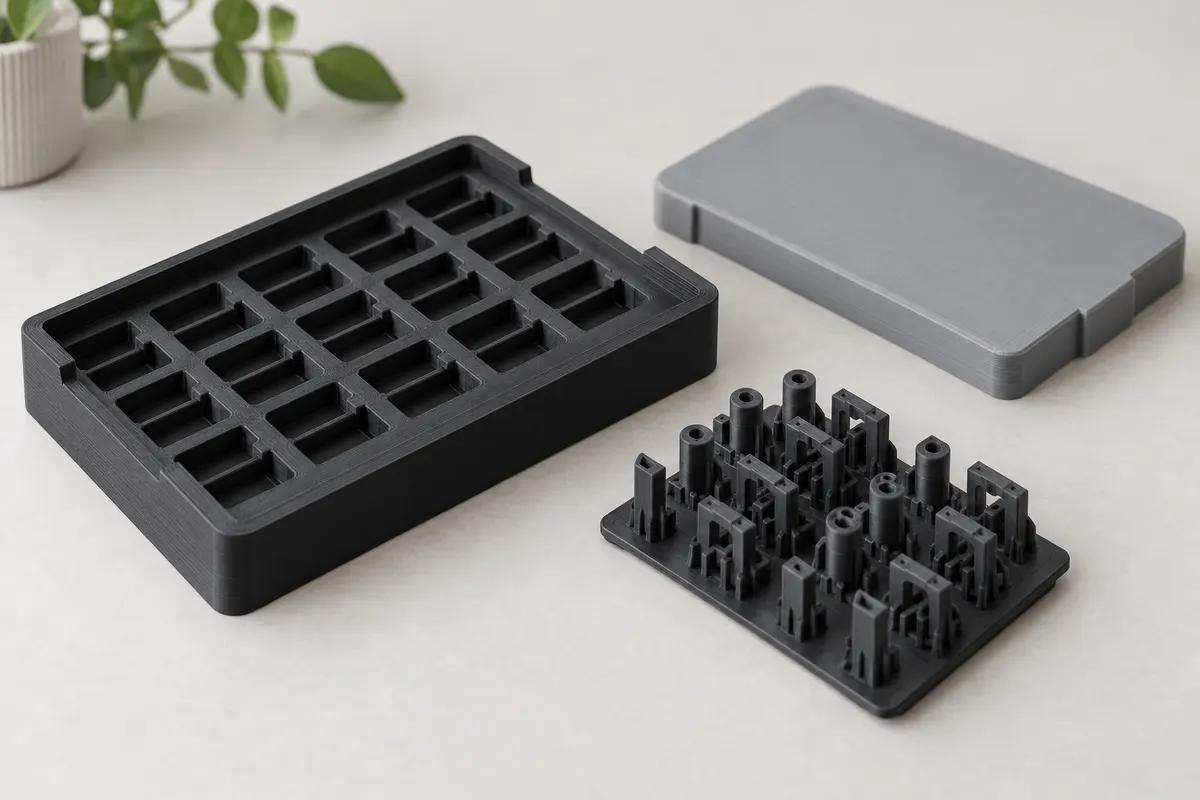
The Short Answer
Specify a static-dissipative part by its resistance, the test method and the test conditions, and require the test on the finished part, not on the material. The ESD Association defines static dissipative as a surface or volume resistance of at least 1.0 × 10⁴ ohms and below 1.0 × 10¹¹ ohms. A filament or resin datasheet reports what its maker measured on its own specimens, and one maker's published data show print settings moving the same filament from the dissipative range into the conductive range. So name the material, then let your ESD program accept the part by measurement.
Conductive, Dissipative and Insulative
The ESD Association's fundamentals series sorts materials into three classes by surface or volume resistance. A dissipative material lets charge drain to ground more slowly than a conductive material of the same size, and much faster than an insulator. An insulator cannot lose its charge by being connected to ground at all, and the Association names most common plastics as insulators. That is why an ordinary printed fixture in PLA or PETG can hold a charge right next to a bare board, and grounding it does not remove that charge.
| Class | Surface or volume resistance | Behavior (ESD Association) |
|---|---|---|
| Conductive | Below 1.0 × 10⁴ ohms | Charge flows easily; fastest transfer |
| Static dissipative | 1.0 × 10⁴ to below 1.0 × 10¹¹ ohms | Slower than conductive, faster than insulative |
| Insulative | 1.0 × 10¹¹ ohms or more | Charge stays put; grounding cannot remove it |
Why Dissipative and Not Simply Conductive
More conductive is not safer. Writing in In Compliance, ESD engineers Carl Newberg, Ted Dangelmayer and Terry Welsher explain that a charged device or board can be damaged by the very fast discharge that happens when it touches a conductive item, so handling materials should be both static dissipative and homogeneous to limit the discharge current. They add that some static dissipative materials can still produce significant and possibly damaging discharge currents, so the class alone is not the whole specification. The ESD Association's own guidance for fixtures is short: holding fixtures should be conductive or static dissipative when possible, dissipative materials are often suggested when very sensitive devices are handled, and a fixture that is not on an ESD worksurface or handled by a grounded person may need its own ground wire.
The Standards and What Each Covers
Your facility's ESD program decides what is acceptable. The ESD Association advises that the program's coordinator keep and control a list of the specific ESD control products permitted in the facility. These are the documents a specification usually points to, described as the Association describes them:
- ANSI/ESD S20.20 is the standard for the development of an ESD control program. It sets administrative and technical requirements for establishing, implementing and maintaining that program for the protection of electrical and electronic parts, assemblies and equipment. IEC 61340-5-1 is technically equivalent. It governs a facility's program; a part does not comply with it on its own.
- ANSI/ESD STM11.11 is a test method for the surface resistance of planar materials in the static dissipative range. It defines the procedure, equipment, sample preparation and conditioning needed for reproducible surface resistance measurements.
- ANSI/ESD STM11.12 does the same for volume resistance of static dissipative planar materials.
- ANSI/ESD STM11.13 is a test method for the resistance between two points on the surface of an item. Unlike STM11.11, it is written for an item rather than a flat sheet of material.
- ANSI/ESD S541 defines the packaging properties needed to protect ESD-susceptible items. Inside a protected area (EPA), packaging and material-handling containers, such as trays and totes, are to be low-charging and dissipative or conductive.
- ESD TR53 gives compliance verification procedures for ESD control items used in programs such as S20.20: the checks that confirm an item in use still meets its requirements.
Read the Units: Ohms or Ohms per Square
Datasheets mix two quantities. STM11.11 measures surface resistance, in ohms. Surface resistivity, in ohms per square, comes from methods such as ASTM D257, and the ESD Association warns against confusing the two: where converting is valid, resistivity values are a factor of ten higher than the resistance values STM11.11 gives. Published datasheets show the mix. Jabil reports its PETg 0800 ESD filament as a surface resistivity of 10⁹ ohms per square or less to STM11.11, and Liqcreate reports its ESD resin in ohms per square by a different method again. The method matters as much as the unit: STM11.11 specifies the test fixture, the environmental conditions, a system verification procedure and the test voltages. Write the quantity, the unit, the method and the test voltage into your specification, and compare datasheets only like for like.
A Datasheet Value Is Not Your Part's Value
Every number on an ESD datasheet was measured on the maker's specimens, made the maker's way. Jabil's datasheet says so: properties may be affected by storage, handling, processing equipment and parameters, and product design, and the data are not a substitute for user testing. Polymaker's published test of its Fiberon PETG-ESD filament shows how large the effect can be. On printed bars measured to ANSI/ESD STM11.11, a 250 °C nozzle gave between about 7 × 10⁶ and 1.6 × 10⁷ ohms depending on direction, 270 °C gave a few times 10⁵ ohms, and 290 °C gave below 10⁴ ohms, which is the ESD Association's conductive range. Polymaker attributes the drop to tighter bonding between shells and between layers at higher temperature.
- Resin parts depend on processing too. Liqcreate states that the values for its ESD resin may vary and depend on the individual machine's processing and on post-curing.
- Direction within a part matters. In a 2024 study of conductive filaments (Nowka et al., Polymers), resistance was lowest along the printed strands and higher across them, which the authors trace to a less-conductive skin on each strand. Those were conductive grades, not dissipative ones, but they show how a printed structure can make resistance depend on direction.
- The setup matters. Protopasta notes that its own published resistance figures depend on its printer, parameters, material batch, test setup and environmental conditions.
- So a test coupon is not the part. Measure the finished part, at the places that touch devices, after every finishing step.
Finishing Changes the Surface
Surface resistance is measured on the outer surface, so anything that removes, covers or contaminates that surface can change the reading.
- Sanding and machining remove the printed skin. Polymaker states that the carbon nanotubes in its PETG-ESD keep the part ESD-safe after machining or wear, and also that conductive additives can wear off or lose effectiveness through surface abrasion, so it recommends regular testing.
- Coatings and residues add a surface. Desco, a maker of ESD control products, warns that cleaners containing silicone leave an insulative residue that can stop conductive or dissipative mats from working, and recommends testing a surface after cleaning. Treat an ordinary paint or coating the same way: assume it is insulative until the finished part measures otherwise.
- Know what is standard here. FDM parts ship as printed with support material removed. On SLA parts, support marks on the bottom face are sanded by default, so that face is not as printed; polish, paint and dye are add-ons. Order an ESD part without paint or dye unless your specification covers them, and include the sanded face in your test.
Humidity and Time
The ESD Handbook (ESD TR20.20), as quoted by Desco, notes that many ESD protective materials degrade at low humidity and some become ineffective, and that materials should be evaluated in controlled environments at the lowest relative humidity expected in use. It adds that they should also be tested at moderate humidity to make sure they do not become too conductive and a hazard to people working with substantial voltages. Polymaker says the ESD performance of its PETG-ESD can degrade over time with humidity, temperature, dust and contaminants. Put the conditioning, the test humidity and the re-test interval into your specification.
Our ESD Material Options
We print two static-dissipative materials and one conductive one. Each part in an order is configured with its own process and material, so an FDM fixture and an SLA carrier can be quoted together.
| Material | Process | Typical use | Electrical class |
|---|---|---|---|
| PETG-ESD | FDM | Fixtures, trays, enclosures | Dissipative, per its maker |
| ESD-Safe Resin | SLA | Fine-detail fixtures and carriers | Dissipative, per its maker |
| Conductive PLA | FDM | Touch sensors, low-current circuits | Conductive; not for ESD control |
Choosing Between Them
- PETG-ESD is carbon-loaded PETG for FDM parts such as assembly fixtures, component trays and enclosures. Its dissipative rating is the filament manufacturer's, measured on that manufacturer's test specimens.
- ESD-Safe Resin is a carbon-loaded resin for SLA parts that need finer detail, such as nests for small components. Its rating is likewise the resin manufacturer's.
- Conductive PLA is a different material for a different job: capacitive touch buttons, low-voltage LED circuits and simple switches. Protopasta says its conductive PLA was designed to conduct beyond dissipative levels and is best thought of as a resistor rather than a wire. In an ESD area it brings back the fast-discharge problem described above, so it is not an ESD control material.
- Neither dissipative material makes a part ESD-certified. A printed part qualifies for your ESD-controlled area only when your program has tested it.
- For the wider family of specialty filaments, see specialty filaments explained. For fixture design, see jigs and fixtures, and for enclosures, the electronics enclosure checklist.
Specification Checklist
| Item | What to specify |
|---|---|
| Class and limits | Dissipative, with your program's lower and upper limits in ohms |
| Quantity measured | Surface resistance, point-to-point, or resistance to ground |
| Test method | ANSI/ESD STM11.11, STM11.13, or your program's method |
| Units | Ohms, not ohms per square, unless your method says otherwise |
| Test voltage | As your method or program states |
| Conditioning | Relative humidity, temperature and time before testing |
| Where measured | Named faces or points on the finished part |
| Finish | As printed; no paint, dye or coating; note sanded faces |
| Grounding in use | How the part connects to ground at the workstation |
| Sampling | How many parts per lot are tested, and by whom |
| Re-verification | Interval and method under your compliance plan |
A Drawing Note, Written Out
Hypothetical example, with blanks for your program's values: Material PETG-ESD, static dissipative per manufacturer's rating. Finish as printed; no paint, dye or coating. Acceptance: surface resistance between ____ and ____ ohms per ANSI/ESD STM11.11, or point-to-point per ANSI/ESD STM11.13, at ____ V, after conditioning at ____ RH and ____ °C for ____ hours, measured on faces A and B of the finished part. Sample: ____ parts per lot, tested by ____. Re-verify every ____ under the compliance verification plan.
Ordering an ESD Part
Upload the part on the quote page, choose FDM with PETG-ESD or SLA with ESD-Safe Resin, and send your specification through the contact page. When you enter your contact details, tick Engineering / DFM review to have an engineer check walls, tolerances, orientation and material choice at no cost. That review is about printability; it does not include electrical testing, so plan the resistance test in your facility or at a lab, and order spare parts if the qualification test is destructive. Quantity pricing tiers are applied automatically, and purchase orders go through the purchase order page.
Frequently asked questions
Is a part printed in ESD filament ESD-certified?
What resistance range counts as static dissipative?
Can I use conductive PLA instead of an ESD material?
Does sanding or painting change an ESD part?
Which test method should go on my drawing?
Sources
- ESD Association: Fundamentals of Electrostatic Discharge, Part 1, An Introduction to ESD
- ESD Association: Fundamentals of Electrostatic Discharge, Part 3, Basic ESD Control Procedures and Materials
- ESD Association: Fundamentals of Electrostatic Discharge, Part 6, ESD Standards
- ESD Association: ANSI/ESD S20.20-2021 (store listing)
- EOS/ESD Association in In Compliance: ANSI/ESD STM11.11-2015 Surface Resistance Measurements of Static Dissipative Planar Materials
- Newberg, Dangelmayer and Welsher, In Compliance (2017): Are Your ESD Tote Boxes and Containers Too Conductive?
- Polymaker: Fiberon PETG-ESD (surface resistivity test report and FAQ)
- Jabil: PETg 0800 ESD Filament technical data sheet
- Liqcreate: Liqcreate ESD resin (product page and properties)
- Protopasta: Dissipative Filaments for ESD Applications (2024)
- Nowka et al., Polymers (2024): Characterization of the Anisotropic Electrical Properties of Additively Manufactured Structures Made from Electrically Conductive Composites
- Desco Industries: Technical Bulletin TB-7000, Reztore Surface and Mat Cleaner
- Desco: Static Control and Relative Humidity (quoting ESD Handbook ESD TR20.20)
Send your ESD part and its specification
Upload the fixture, tray or enclosure, choose PETG-ESD or ESD-Safe Resin, and send your resistance specification through the contact page.
Upload your ESD part