Clear 3D Printed Parts: Clear Resin vs Translucent FDM
How to get a clear or see-through printed part: why FDM prints come out translucent, how clear resin is polished to transparency, yellowing and what to specify.
The Short Answer
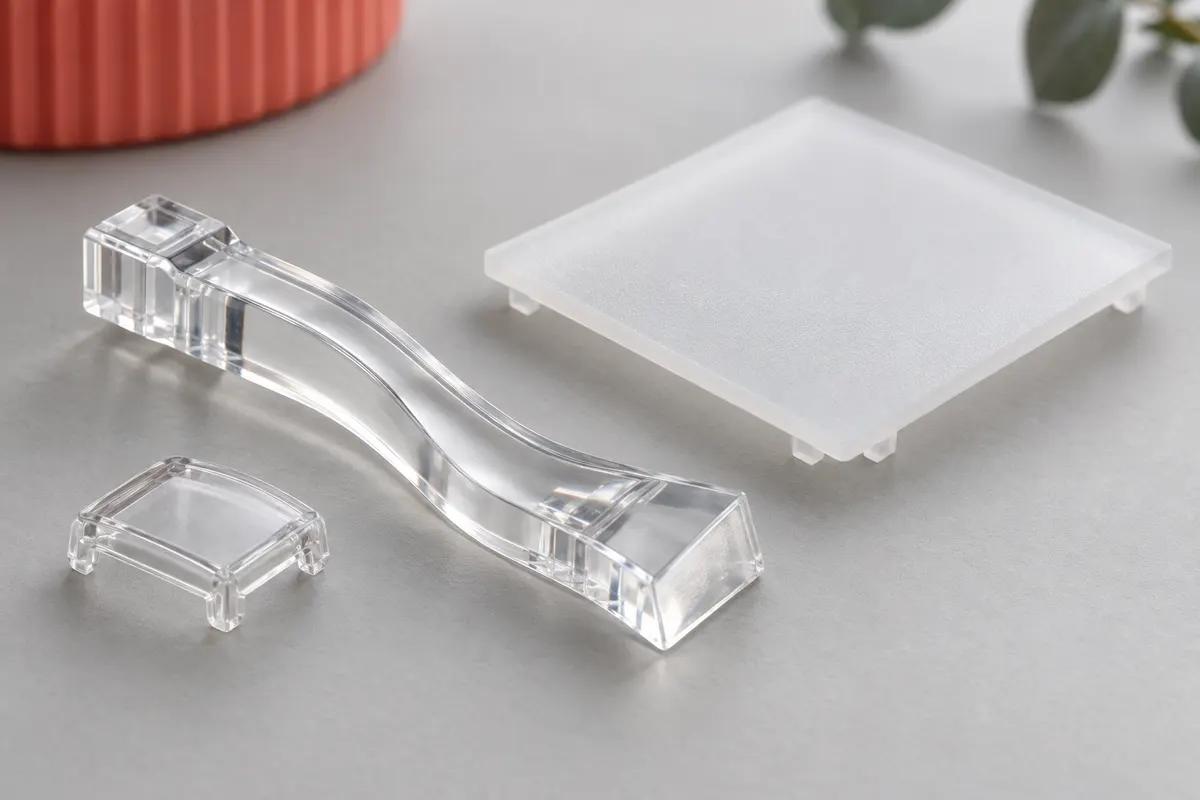
For a part you need to see through, print it in clear SLA resin and order the polish add-on for the faces that matter. A part printed in clear FDM filament lets light through but blurs what is behind it, because light scatters at tiny gaps between extruded lines and at bubbles inside them. That makes clear FDM a good fit for light covers, diffusers and indicator windows, and a poor fit for a viewing window. No printed part is an optical-grade lens, and we do not measure haze or light transmission.
Transparent, Translucent or Diffusing
Clear means different things to different people, so name the result you need. ASTM D1003, the standard test for haze and luminous transmittance of transparent plastics, describes the problem: light scattered on its way through a material produces a hazy or smoky field when you look through it. The standard measures how much light gets through (luminous transmittance) and how much of it is scattered (haze) on flat specimens, and treats a material with haze above 30 percent as diffusing. A printed part can land in any of three places:
| You need | What you see | Printed route |
|---|---|---|
| Transparent | Objects behind it look sharp | Clear resin, polished |
| Translucent | Light passes, objects blur | Clear FDM, or unpolished clear resin |
| Diffusing | An even glow, no image | Translucent or tinted FDM, as printed |
Why Clear Filament Prints Come Out Translucent
Molded PETG transmits light well and printed PETG does not. A peer-reviewed study in BioResources (Wang et al., 2024) attributes the difference to irregular refraction and scattering inside the print, caused by the fill pattern and two kinds of defect: bonding-neck gaps, the small voids left where neighboring extruded lines meet, and bubble cavities, formed when moisture in the filament turns to vapor in the hot nozzle. The study names densification, homogeneity and thickness as the factors that matter most, and ASTM D1003 notes that surface defects affect haze as well as internal ones, so the layer lines on the outside can add to the blur.
- The study printed every specimen solid, with lines parallel to the long edge. Of the three layer heights tested (0.1, 0.2 and 0.3 mm), 0.2 mm transmitted the most light.
- A slightly higher extrusion rate than standard filled the gaps and helped, but the highest rate tested made things worse, and the thinnest layers packed the material densely but made the specimen thicker, which absorbed more light.
- The faster of the speeds tested left fewer bubbles, because the filament spent less time heating in the nozzle.
- Those results come from one printer and one filament, so treat them as a direction, not a recipe. On the design side, they favor clear sections that are solid and no thicker than the part needs.
Clear FDM Materials Compared
Each of these prints translucent, not transparent. They differ in toughness, heat resistance and finish.
| Material | Best for | Watch for |
|---|---|---|
| Translucent PETG | Tinted light covers, diffusers, indicator lenses | Translucent, not see-through |
| PCTG | Clear covers and guards that get knocked | Clarity varies by grade |
| Polycarbonate (PC) | Light covers near heat or impact | Some grades are made to diffuse light |
| PVB (Smoothable) | Display models smoothed with alcohol | Smoothing lowers strength and heat resistance |
What the Makers Say
- PCTG: Spectrum Filaments says parts in its PCTG Premium transparent colors are clearer than their PET-G counterparts, and that a near-transparent effect is possible on parts with few external contours. Clarity belongs to the grade, so judge it on a sample.
- Polycarbonate: Polymaker describes its PolyLite PC filament as having light diffusing properties, which suits a glowing cover better than a window.
- PVB (Smoothable): Polymaker's PolySmooth is smoothed with isopropyl alcohol to remove layer lines. Polymaker says alcohol smoothing sacrifices strength and heat resistance and advises against it for functional parts, and its datasheet lists an HDT of 66 °C at 1.8 MPa. Smoothing works on the surface; it does not fill the internal gaps described above. It is also not among the post-processing options we list for FDM parts.
- Translucent PETG is our tinted, light-transmitting PETG for covers and diffusers that also have to be functional parts. For other appearance filaments, see specialty filaments explained.
- Our FDM post-processing options (sanding, vapor smoothing for ABS and ASA, painting, dyeing, threaded inserts and assembly) do not include a polish to transparency, so plan FDM clear parts around how they look as printed. See the post-processing guide.
Clear Resin: Transparent Only After Finishing
Liqcreate, a resin maker, notes that resin printing is one of the few 3D printing processes that can make high-resolution transparent plastic parts, but describes a catch: a clear part looks transparent fresh from the printer, turns frosted as the washing solvent dries, and needs post-processing to become lastingly transparent. It lists four routes: sanding through progressively finer grits and then polishing, which it calls effective for simple shapes such as lenses, prisms and solid microfluidic parts; dipping in resin; curing a thin resin film under nitrogen; and spray coating with clear acrylic. What that means for an order:
- On our SLA parts, support marks on the bottom face are sanded by default, and polish, paint and dye are add-ons. A part that must be see-through needs the polish add-on in Clear Resin.
- Liqcreate notes that polishing suits parts that are not too complex to reach by hand or with a wheel. Internal channels, deep pockets and fine textures stay frosted, so make see-through faces open and flat or gently curved.
- Say which faces must be clear. Orientation decides where support marks fall, and a mark on a viewing face has to be polished out.
- For choosing among clear, tough and specialty resins, see how to choose an SLA resin.
Yellowing: Resin, Post-Cure, Heat and Sunlight
A clear part shows discoloration that an opaque part hides. The makers name four causes:
- Resin chemistry. Liqcreate says low-quality raw materials and impurities can cause extra yellowing over time, and that epoxy resins are notorious for discoloration.
- Post-cure. Liqcreate recommends post-curing clear parts at room temperature, in short steps, because at elevated temperatures side products can cause extra yellowing.
- Heat in service. Liqcreate lists an HDT of 44 °C at 1.80 MPa for its Clear Impact resin and notes that its printed parts soften above HDT and show cracks and yellowing above 100 °C. A clear part near a lamp or a motor needs its temperature checked (heat-resistant materials).
- Sunlight. UV resistance belongs to the grade. Covestro, for example, describes a UV infusion process for its Makrolon polycarbonate lens grades that lets them resist yellowing from long-term UV exposure, with minimal change in yellowness, light transmission and haze. A printed part has only the protection its grade provides, so check that before a clear part goes outdoors.
Light Pipes, Lenses, Windows and Covers
These jobs ask different things of a clear part, and only some suit printing.
| Part | What it needs | Printed route |
|---|---|---|
| Cover or diffuser | Even glow, toughness | Translucent PETG, PCTG or PC |
| Indicator window | Light visible from outside | Clear FDM or clear resin |
| Light pipe | Smooth walls, gentle bends | Clear resin, polished, short path |
| Viewing window | Flat faces, sharp view | Clear resin, polished both sides |
| Imaging lens | Exact optical surfaces | Shape and look prototype only |
Designing Light Pipes and Lenses
- Light pipes work by total internal reflection: light that meets the wall at more than the material's critical angle reflects back inside. VCC, a light pipe maker, notes that most light pipes are acrylic or polycarbonate and that bend radius and thickness affect how much light gets through.
- Keysight explains that the tighter the bend, the more light escapes, and that light guides use small surface textures on purpose to send light out. Unpolished walls and layer lines on a printed pipe work the same way, as unplanned exits, so keep the path short, the bends gentle and the walls polished.
- A lens that forms an image depends on the exact shape of its surfaces. Our published typical tolerances, FDM ±0.2 mm and SLA ±0.1 mm (geometry-dependent, not a guarantee), are for mechanical fit, so treat a printed lens as a shape and appearance prototype.
- For a window that must give a sharp view, a common design is a printed frame that holds a flat sheet of clear plastic or glass.
What a Printed Clear Part Cannot Promise
We do not sell printed parts as optical components, and we do not measure haze, transmittance or refractive index. If a specification calls for those numbers, ASTM D1003 is the standard method, on flat specimens, so the practical route is to print and finish flat coupons in the candidate material and process and have them measured. A printed clear part also carries its material's limits: the heat and UV behavior above, and for FDM, the internal scattering described above.
Checklist for a Clear Part
- Name the result: transparent (see through), translucent (light through) or diffusing (even glow).
- Mark the faces that must be clear, and keep them open and flat or gently curved so they can be polished.
- Choose the route: clear resin with the polish add-on for see-through parts, or a translucent filament for glowing covers.
- Check the temperature near lamps or electronics, and the grade's UV resistance for outdoor use.
- Do not rely on internal channels or deep pockets being clear.
- For light pipes: short path, gentle bends, polished walls.
- If you need haze or transmittance numbers, plan coupon testing in your own or a third-party lab.
- Upload to the quote page and choose the process and material for each part. One order can mix FDM and SLA parts (mixing FDM and SLA). Tick Engineering / DFM review if you want an engineer to check orientation and material choice, at no cost and with no obligation to order.
Frequently asked questions
Can you 3D print a fully transparent part?
Is clear PETG filament see-through when printed?
Will a clear resin part turn yellow?
Can a 3D printed part work as an optical lens?
What is the best way to print a light pipe?
Can I order a clear part and an opaque housing together?
Sources
- ASTM International: D1003-21, Haze and Luminous Transmittance of Transparent Plastics
- BioResources (Wang et al., 2024): Effect of Slicing Parameters on the Light Transmittance of 3D-printed PETG Products
- Spectrum Filaments: PCTG Premium
- Polymaker: PolyLite PC technical data sheet
- Polymaker: PolySmooth technical data sheet
- Polymaker: Smoothing
- Liqcreate: How to get a clear surface finish on 3D-printed parts
- Liqcreate: Clear Impact resin
- Covestro: Makrolon Polycarbonate for Outdoor Lighting Applications
- VCC: Light Pipe Design, How TIR and Refraction Come into Play
- Keysight: What Is a Light Guide?
Upload your clear part
Upload the CAD file, choose clear resin or a translucent filament for each part, and tell us which faces must be see-through.
Get a quote