3D Printing for Aerospace and Defense Applications
How aerospace teams use 3D printing for prototypes, tooling and non-flight-critical parts: materials, controlled data, and quality expectations.
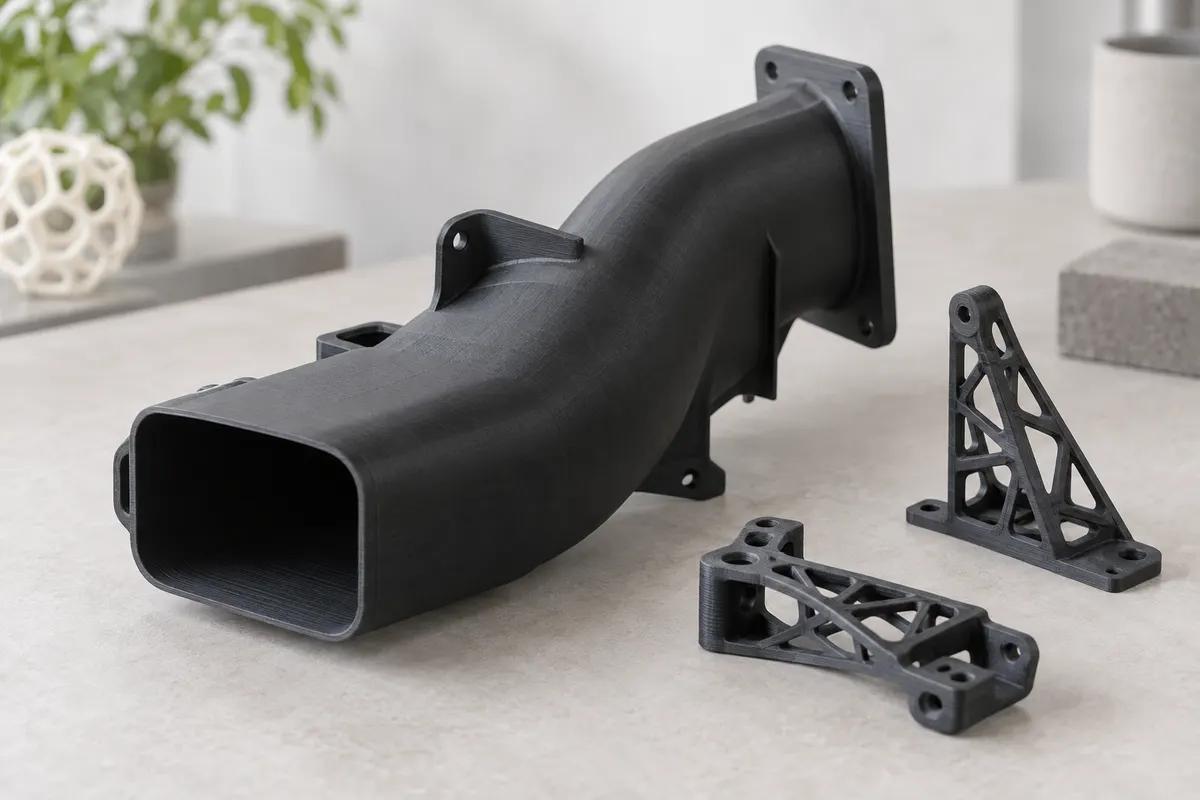
Additive's Most Demanding Customer
Aerospace adopted 3D printing earlier and deeper than almost any industry, because its economics are additive's sweet spot: low volumes, extreme lightweighting incentives, complex geometry, and certification regimes that reward part-count reduction. While headlines focus on printed rocket engines, the everyday aerospace additive workload is more practical — tooling, fixtures, ducting, brackets, and development hardware — and that's where a polymer printing partner fits.
Where Polymer Printing Serves Aerospace Programs
The applications we support most often:
- Development prototypes: fit-check hardware for avionics trays, connector panels, and cable routing before committing to machined metal.
- Manufacturing aids: drill guides, bonding fixtures, masking templates, and assembly jigs — printed in days, iterated freely, at a fraction of machined tooling cost.
- Non-structural flight-adjacent parts: interior trim mockups, ECS ducting prototypes, sensor housings for flight test instrumentation.
- Ground support equipment: protective covers, shipping cradles formed to part geometry, and test-stand adapters.
- High-temperature duty: PAHT-CF, PPS-CF, and high-temp SLA resin cover fixtures that see thermal cycles, cure ovens, and hot-air environments.
Materials and Their Aerospace Roles
Material selection maps to the demands of each application class:
| Material | Aerospace role |
|---|---|
| PC (Polycarbonate) | Impact-critical covers, transparent guards |
| PA-CF / PAHT-CF | Stiff, light brackets and fixtures; ESD-adjacent tooling |
| PPS-CF | Chemical + heat resistant fixtures (fuels, hydraulic fluid) |
| PLA Aero | Lightweight aerodynamic models and wind-tunnel hardware |
| High-Temp SLA resin | Autoclave-tolerant tooling, precision ducting models |
| ASA | UV-stable exterior GSE and outdoor enclosures |
ITAR and Data Handling
Defense-related work brings export-control obligations, and the file handling matters as much as the printing. Our infrastructure is US-based: uploads, storage, and processing stay on domestic servers, files transfer over TLS and rest encrypted, access is role-restricted, and NDAs are standard practice (we countersign yours or provide ours during checkout). For programs with explicit ITAR data-handling requirements, contact us before uploading and we will confirm the appropriate handling path for your data classification.
Quality Expectations
Aerospace customers bring aerospace expectations, and the honest framing is this: polymer 3D printing serves the prototype, tooling, and non-flight-critical tiers of the industry. Parts are printed to the published typical tolerances (±0.2 mm FDM, ±0.1 mm SLA), which are general guidance that depends on geometry. If your program needs material traceability or first-article documentation, say so before ordering so the team can confirm what it can supply for that order. For flight-critical certified hardware, programs move to qualified metal AM or traditional processes — usually after the printed-polymer phase has compressed months out of the development schedule.
A Hypothetical Example
Hypothetical example: a UAV team revises a sensor gimbal housing between flight tests, each revision answering the vibration data from the last flight. Printing each revision in PA-CF, instead of machining it, removes the setup between tests, and the final geometry is machined in aluminum once it stops changing. That pattern, many quick revisions before one committed design, is where printed polymers earn their place in aerospace development.
Start With Your Hardest Fixture
The lowest-risk way to evaluate printing for an aerospace program is a manufacturing aid: pick a non-export-controlled jig or fixture currently stuck in the machine-shop queue, upload it, and check the ship date on the quote. For anything subject to ITAR or other export-control restrictions, contact us before uploading — per the data-handling section above — and we'll confirm the appropriate path first.
Ready to Start Your Project?
Upload your CAD files and get an instant quote. Our engineers will review your design for printability, free.
Get Instant Quote